
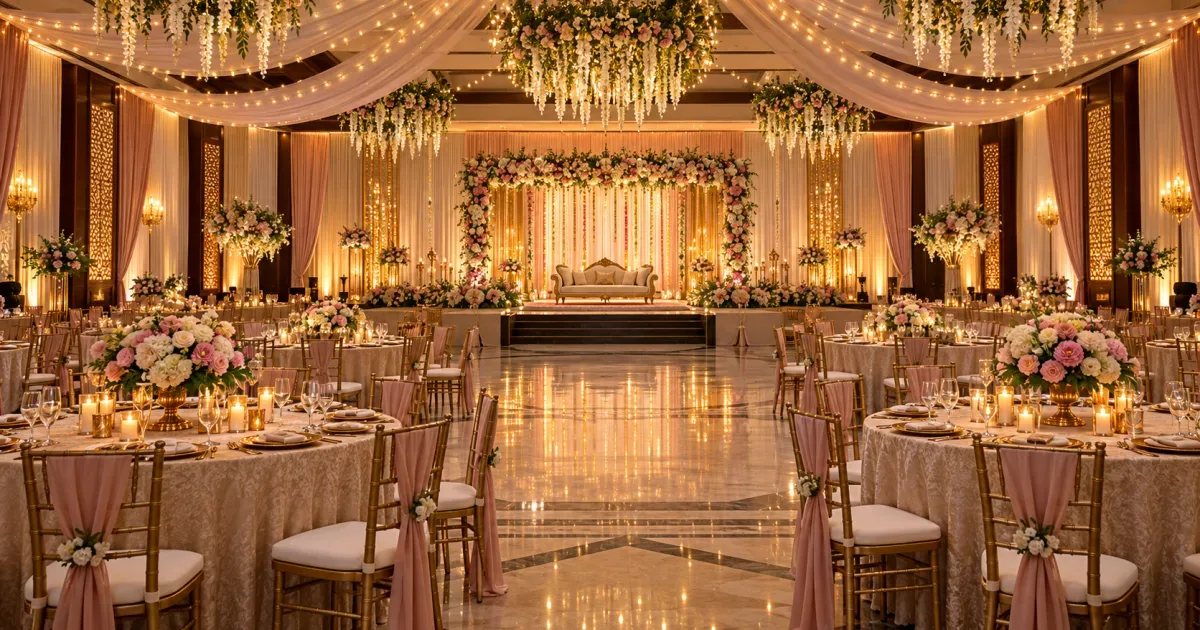
A banquet hall makes money on dates. An empty Saturday in December is a catastrophe; a fully booked wedding season is a very good year. Everything in between is a marketing problem — and digital marketing for banquet halls is how you solve it: a steady pipeline of enquiries from couples, families and event planners, converted into confirmed bookings on the dates you need to fill.
The challenge is that a banquet booking is a big, emotional, high-value decision. Nobody books a wedding venue on impulse. They research for weeks, visit multiple halls, compare prices and photos, and ask everyone they know. Your marketing has to show up at every one of those moments — and then follow up relentlessly, because the enquiry is only the beginning.
This guide lays out exactly how to keep the calendar full, built for Indian banquet halls competing for weddings, receptions and corporate events.
Understand the banquet buyer journey first
You cannot market a venue the way you market a restaurant. The decision is slower, involves more people, and carries far higher stakes. A typical journey looks like this:
- Trigger: an engagement, a milestone, a company offsite gets approved.
- Research: they Google “banquet halls near me”, scroll Instagram, ask friends, browse venue listings — often on their phone, late at night.
- Shortlist: they save three to five venues based on photos, reviews, location and whether they can find the price.
- Enquiry: they fill a form, call, or WhatsApp for availability and a quote.
- Visit: they tour the shortlisted venues.
- Decision: often weeks later, after comparing and negotiating — and frequently after a follow-up nudge.
Your marketing must do two jobs: get discovered during research, and capture and nurture the enquiry so you are still in the running at decision time. Most halls do the first badly and the second not at all — which is where the opportunity is.
Get found: the discovery channels that matter
Google Business Profile — your single most valuable asset
When someone searches “banquet hall in [area]” or “wedding venue near me”, Google shows a map with three listings. Being in that Map Pack is worth more than almost anything else you can do, because these are people actively looking to book, right now, near you.
Your Google Business Profile needs to be complete and alive: correct categories, a long photo gallery (hall decorated, stage, dining, parking, exterior), seating capacity, amenities, weekly posts, and — critically — a steady stream of reviews. A venue with 120 reviews at 4.6 stars beats a prettier hall with 11 reviews every time.
This is detailed, ongoing work, and it is the highest-ROI thing most banquet halls ignore. We wrote a full walkthrough on Google Business Profile optimisation for Indian local businesses — treat it as required reading for your venue.
A website that answers the real questions
A couple shortlisting venues wants to know four things fast: capacity, photos, price indication, and availability. If your website hides these — or you have no website, just an Instagram page — you fall off the shortlist. Your site should have:
- A gallery of real events (not just empty-hall shots) and a venue video tour.
- Clear capacity figures for different layouts (theatre, round-table, buffet).
- A pricing indication or “packages from ₹___” — hiding price loses serious enquiries.
- An enquiry form that asks for date, event type and guest count, plus a prominent WhatsApp button and phone number.
Instagram and Facebook — the inspiration layer
Weddings are visual and aspirational, and Instagram is where families gather ideas. Your social presence is both a portfolio and a trust-builder. The restaurant and hospitality playbook translates directly here — the same content principles we cover in our Mumbai social media playbook for restaurants apply to venues, with a wedding-and-events spin.
Content that sells a venue
Rotate these formats. Each reassures a nervous, high-spending buyer.
- Real event Reels: a decorated mandap, the entry, the lighting at night, a packed reception. This is the single most persuasive content you have — it lets a couple picture their own day in your space. Film every event you host (with the client’s permission).
- Venue walkthroughs: a smooth phone tour of the hall, stage, dining area, parking and getting-ready rooms. Answers “will it fit us?” without a site visit.
- Decor transformations: empty hall to fully styled — the before/after that shows your canvas and your range.
- Behind-the-scenes setup: the team turning the space around in hours. Builds trust in your execution.
- Testimonials and reviews: a happy couple on camera, or a re-shared thank-you message, does more than any sales pitch.
- Seasonal and capacity posts: “Now booking December 2026 dates”, “Mehendi, sangeet and reception under one roof”, “Corporate offsites — up to 300 guests”.
Lead generation: filling the enquiry pipeline
Discovery brings people who find you. Lead generation goes out and creates demand. For banquet halls, the combination below works reliably.
Meta lead ads (Facebook & Instagram)
This is the workhorse for venues. Meta lets you target people by location (your city plus the surrounding areas couples travel from), and run ads that collect enquiries right inside Instagram or Facebook — no website needed to submit. A good banquet lead ad has:
- A short, gorgeous Reel of a real event.
- A clear hook: “Planning a wedding in Mumbai? See available 2026–27 dates.”
- A simple lead form asking for name, phone, event date and guest count — nothing more.
- An instant auto-response so the lead hears from you within seconds, not hours.
Lead ads are inexpensive relative to a booking. Even if a wedding booking is worth several lakhs, you are spending a small fraction of that to generate each qualified enquiry — the economics are strongly in your favour when the follow-up is handled well.
Google Search ads for high intent
Someone typing “banquet hall in [your area] for wedding” is far down the funnel — they are ready to enquire. A tightly targeted search ad that captures these searches, pointing to a focused landing page with photos, capacity and an enquiry form, converts well because the intent is already there.
Website enquiry and WhatsApp capture
Make enquiring effortless and immediate. A WhatsApp click-to-chat button with a pre-filled “Hi, I’d like to check availability and pricing” turns a hesitant browser into a conversation. Indian families overwhelmingly prefer WhatsApp for this kind of back-and-forth — meet them there.
The part everyone gets wrong: follow-up
Here is the uncomfortable truth about banquet marketing: most lost bookings are not lost at the ad or the website. They are lost after the enquiry, because nobody followed up properly. A family enquires with four venues, two reply the next day, one replies instantly with photos and a price — guess who gets the visit.
Speed wins
Respond to every enquiry within minutes, not hours. The venue that replies first, while the couple is still in planning mode, is dramatically more likely to get the site visit. If your team cannot watch the inbox around the clock, automate the first response.
Automate the first touch, then go human
An automated WhatsApp or Instagram reply can instantly send the enquirer a photo gallery, a short video, a starting price and a question — “What’s your event date and expected guest count?” — then hand off to your sales person with the context already captured. No enquiry sits unanswered overnight. We build exactly these flows with our AI automation service, and for a high-value booking, this single fix often pays for the whole marketing budget.
Nurture the slow deciders
A wedding venue decision can take weeks. Keep a simple record of every enquiry — name, date, guest count, status — and follow up: a gentle “Is your date still open? We’ve just had a December Saturday free up.” A structured follow-up sequence over two to three weeks recovers bookings that would otherwise quietly go to a competitor.
A sample monthly playbook
| Activity | Frequency | Goal |
|---|---|---|
| Real-event Reels | 2–3 / week | Discovery + portfolio |
| Google Business Profile posts | 1–2 / week | Map Pack ranking + freshness |
| Ask every event client for a review | Every event | Build review volume |
| Meta lead ads | Always on | Enquiry pipeline |
| Google Search ads | Peak season | Capture high intent |
| Follow-up on open enquiries | Daily | Convert enquiries to visits |
| Seasonal availability posts | Monthly | Drive urgency on open dates |
Work with the seasonality, not against it
Banquet demand in India is intensely seasonal — wedding season (broadly October to February, with regional variation and auspicious-date clustering) is a flood, and the off-season can be quiet. Smart marketing shapes spend around this:
- Before peak season: ramp ads hard, because couples book wedding venues months in advance. The enquiries you generate in July become December bookings.
- During peak: keep discovery strong and focus energy on fast follow-up — demand is there, conversion is the bottleneck.
- Off-season: pivot to other revenue — corporate events, birthdays, anniversaries, conferences, exhibitions, religious functions. Market the hall as a flexible event space, not only a wedding venue. Run off-season offers to fill otherwise dead dates.
Filling the off-season with non-wedding events is often where the real profit growth is, because that capacity would otherwise earn nothing.
Reviews: the quiet engine of bookings
For a decision this big, social proof is decisive. A venue with a deep bank of genuine, recent reviews reassures a family spending lakhs on the most important day of their lives. Build reviews systematically:
- Ask every client, right after a successful event while they are delighted, to leave a Google review.
- Send the direct review link over WhatsApp — do not make them search.
- Respond to every review, good or bad, professionally. Prospects read your responses.
- Re-share the best ones on Instagram and your Google Business Profile.
Common mistakes banquet halls make
- No follow-up system: generating enquiries and then letting them go cold is the most expensive mistake in this business.
- Hiding prices entirely: serious buyers want a ballpark; total opacity gets you skipped, not called.
- Only empty-hall photos: couples need to see real, decorated, full events to imagine their own.
- Ignoring Google Business Profile: missing the Map Pack means missing the highest-intent searchers in your area.
- Treating marketing as seasonal-only: wedding bookings happen months ahead, so going dark in the off-season means an empty peak season.
- Running ads with no capacity to answer leads fast: paying to generate enquiries you then answer two days later is pouring money away.
Frequently Asked Questions
What is the best channel to get banquet hall bookings?
A combination: Google Business Profile and Search ads capture people actively searching to book, while Meta (Instagram/Facebook) lead ads create demand and fill your enquiry pipeline. Underpinning both, a complete profile with strong reviews and fast follow-up is what actually converts enquiries into bookings.
How much should a banquet hall spend on digital marketing?
It varies with your market and capacity, but because a single wedding booking is worth lakhs, even a modest monthly ad budget can be highly profitable if follow-up is handled well — you are spending a small fraction of one booking’s value to generate many qualified enquiries. Start measured, track cost per confirmed booking, and scale what works.
Do I need a website, or is Instagram and Google enough?
You can generate enquiries through Instagram, Meta lead ads and Google Business Profile alone, but a website that clearly shows capacity, real-event photos, pricing indication and an enquiry form strengthens every channel — it is where serious couples go to decide whether to shortlist you. For a high-value booking, it pays for itself.
How do I fill dates in the off-season?
Market the hall beyond weddings — corporate events, conferences, birthdays, anniversaries and religious functions. Run off-season offers to fill otherwise empty dates, and position the venue as a flexible event space. That otherwise-idle capacity is often where the biggest profit growth sits.
Why do I get enquiries but few bookings?
Almost always a follow-up gap. Banquet decisions take weeks and families enquire with several venues; the one that replies fastest, with photos and a price, and keeps following up gets the visit and the booking. Instant first response (automated if needed) and a structured follow-up sequence usually fix this immediately.
How do I choose a marketing agency for my venue?
Look for one that understands lead generation and follow-up, not just pretty posts — ask how they capture and nurture enquiries, how they report on cost per booking, and whether they handle Google Business Profile and automation. Our guide on how to choose a digital marketing agency in Mumbai covers the right questions and red flags.
Where the lead tools for digital marketing for banquet halls live
The lead-generation side of digital marketing for banquet halls runs on two platforms. Their official documentation is the place to verify how targeting and listings actually work.
- Meta Business Help Centre — official Instagram and Facebook ads guidance.
- Google Business Profile Help — Google’s official Map Pack and listing documentation.
Keep your calendar full — let’s talk
A banquet hall does not need more marketing noise. It needs a reliable flow of enquiries, instant follow-up, and a presence that shows up the moment a couple starts searching. That is the system we build.
Hype Marketer runs end-to-end digital marketing for banquet halls and event venues — real-event content, Meta and Google lead generation, Google Business Profile, and WhatsApp follow-up automation that makes sure no enquiry goes cold. Talk to our team about filling your peak season and reviving your off-season dates.
3 thoughts on “Digital Marketing for Banquet Halls: How to Keep Your Calendar Full”